
Why Singapore's Prime District Is No Longer What You Think
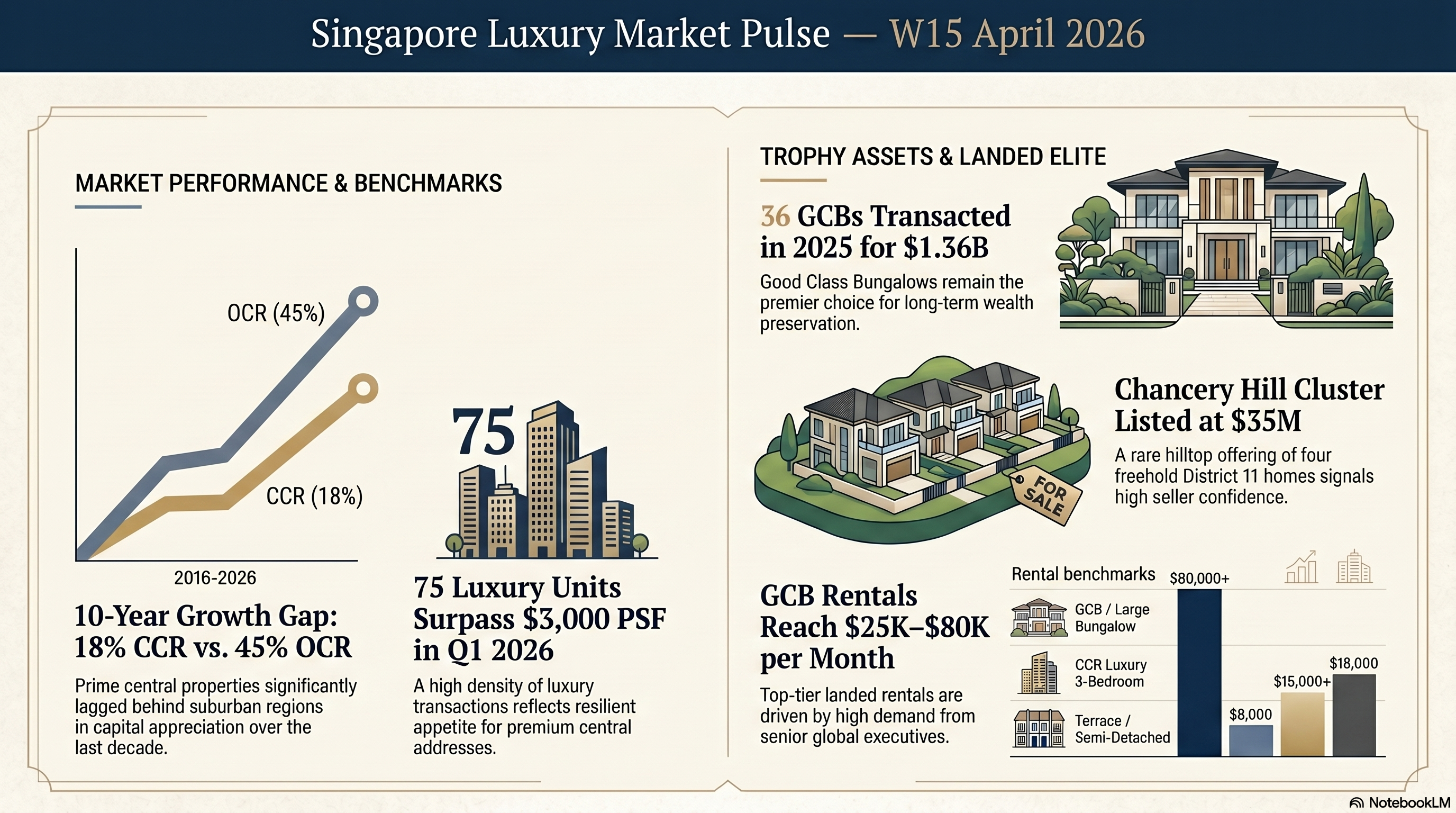
The Core Central Region returned just 18% over 15 years while the suburbs hit 45%. Here is what that actually means if you are buying, holding, or planning to exit a CCR property in 2026.
I want to challenge an assumption that has driven millions of dollars of property decisions in Singapore for decades: that buying in the prime district is automatically the safest, most profitable move you can make.
The data from the week of 14 to 18 April 2026 tells a more complicated story. And I think every buyer, owner, and investor in Singapore deserves to see it plainly.
The 15-Year Growth Gap Nobody Talks About
From 2010 to 2025, capital appreciation across Singapore's three market regions broke down like this:
A buyer who entered an OCR project at $900 PSF in 2010 is up roughly 44% today. A comparable CCR buyer who entered at $2,500 PSF is up just 18% nominally, and often at a negative real return once you account for mortgage interest, maintenance fees, and the opportunity cost of capital tied up over 15 years.
These are not fringe cases or poorly located condos. They are the predictable outcome of three structural conditions that have permanently altered the math of prime real estate in Singapore.
The Three Structural Risks Eroding Aging CCR Values
1 The ABSD Wall
The 60% Additional Buyer's Stamp Duty on foreign purchases eradicated the traditional investor pool that once provided deep liquidity for small-format CCR units. The replacement domestic buyer pool does not want 1-bedder investor formats. If your unit was designed for a foreign investor audience, that audience is largely gone.
2 The School Squeeze
Local upgraders now dictate the resale market. They need a primary school within 1km for the Phase 2C ballot priority. Many District 1 and District 9 CBD condos simply cannot offer this. If you cannot attract the largest and most motivated buyer segment in Singapore, your exit market shrinks dramatically and so does your price ceiling.
3 Lease Gravity
Bank LTV valuations drop sharply once a 99-year leasehold crosses the 20-year age mark. Once financed buyers are frozen out and only cash buyers can transact, your pool of potential purchasers becomes a fraction of what it once was. This is not a risk on the horizon. For condos built between 2000 and 2007, it is already here.
Where Safety Actually Exists in 2026
My read of the current market is that prime has fractured into distinct quadrants. Safety exists only at the extremes, not in the middle.
| Quadrant | Asset Type | Risk Level |
|---|---|---|
| Growth Engine | Mega-project OCR/RCR near top primary schools | Lower risk |
| Safe Haven | Ultra-rare GCBs, heritage freeholds, conservation shophouses | Lower risk |
| Danger Zone | Aging small-format CCR 99-year leaseholds, no school anchor, no MRT integration | Highest risk |
The ultra-prime tier is functioning exactly as a wealth preservation asset class should. Singapore has the highest share of $10M-plus trophy homes globally at 5.2%. In Q1 2026, 75 luxury units crossed $3,000 PSF. GCBs are renting at $25,000 to $80,000 per month and 36 transacted in 2025 for a combined $1.36 billion. High-net-worth capital continues to rotate into irreplaceable freehold assets that cannot be replicated by new supply.
But in the squeezed middle, aging leasehold CCR condos with no domestic demand anchor face compounding structural headwinds that no amount of market optimism will reverse.
What This Means for Expat Renters Right Now
If you are an expat signing a new lease in 2026, rental fever has broken and you have genuine negotiating leverage. Supply completions have restored balance. CCR 2-bedroom rents have softened from $9,000 to around $7,200 per month from their 2023 peak. 3-bedroom units that were hitting $13,000 per month are now transacting closer to $10,500.
My advice: push for a 2-year lock-in at negotiated rates now. Landlords holding premium CCR units are still maintaining firm price floors, but they are also more willing to negotiate on lease length than at any point in the last three years.
My Take
The definition of prime in Singapore is being rewritten in real time. It is no longer about the address on the postal code. It is about which quadrant your asset sits in, whether the domestic buyer can access it, and whether the lease still has enough runway to preserve bank financing.
If you own a CCR property, the strategic question is not whether to sell, it is whether your specific unit has the domestic utility anchor (school proximity, MRT integration, family-sized format) that keeps you in the safe zone as the lease ages. If it does not, the window to exit ahead of the 20-year LTV haircut is narrowing.
If you are a buyer, the data points toward freehold landed, conservation-status properties, or large-format CCR units above 2,400 square feet that are immune to the generic new-launch supply shocks hitting the small-format investor segment.
Want a Read on Your Specific Property?
I work with owners and buyers across CCR, RCR, and the landed segment. If you want to know which quadrant your property or target unit sits in, let's have a conversation.
WhatsApp Keith - +65 9750 1055General information only. Estimates only, not guaranteed, figures may change. Data referenced is based on publicly available market information at time of publication and is subject to change. Past performance is not indicative of future results. Keith Tan Boon Kee, ERA Realty Network Pte Ltd (CEA Reg. No. R003793E). Always seek independent professional advice before making property decisions.