On Friday, 8 May 2026, Minister for National Development Chee Hong Tat announced the most significant overhaul to Singapore's Executive Condominium scheme since 2013. Three changes. Each one meaningful on its own. Together, they fundamentally rewrite the upgrade calculation for Singapore's middle-income households.
If you have been planning your HDB-to-EC upgrade based on the old rules, that plan needs a complete review. Here is the honest insider read on what changed, why it happened, and what you should do next.
The 8 May Policy Earthquake: Three Changes That Rewrote the EC Playbook
The government's rationale was data-driven. Between 2021 and 2025, an extraordinary 75% of ECs transacted on the open market were sold within five years of hitting their Minimum Occupation Period. Compare that to 45% in the prior five-year period. At the same time, first-timer EC buyers fell from 50% of all buyers in 2020 down to just 30 to 40% by 2024 and 2025. A product designed for genuine owner-occupiers had become a short-to-medium term speculative vehicle. The government moved decisively to close that loophole.
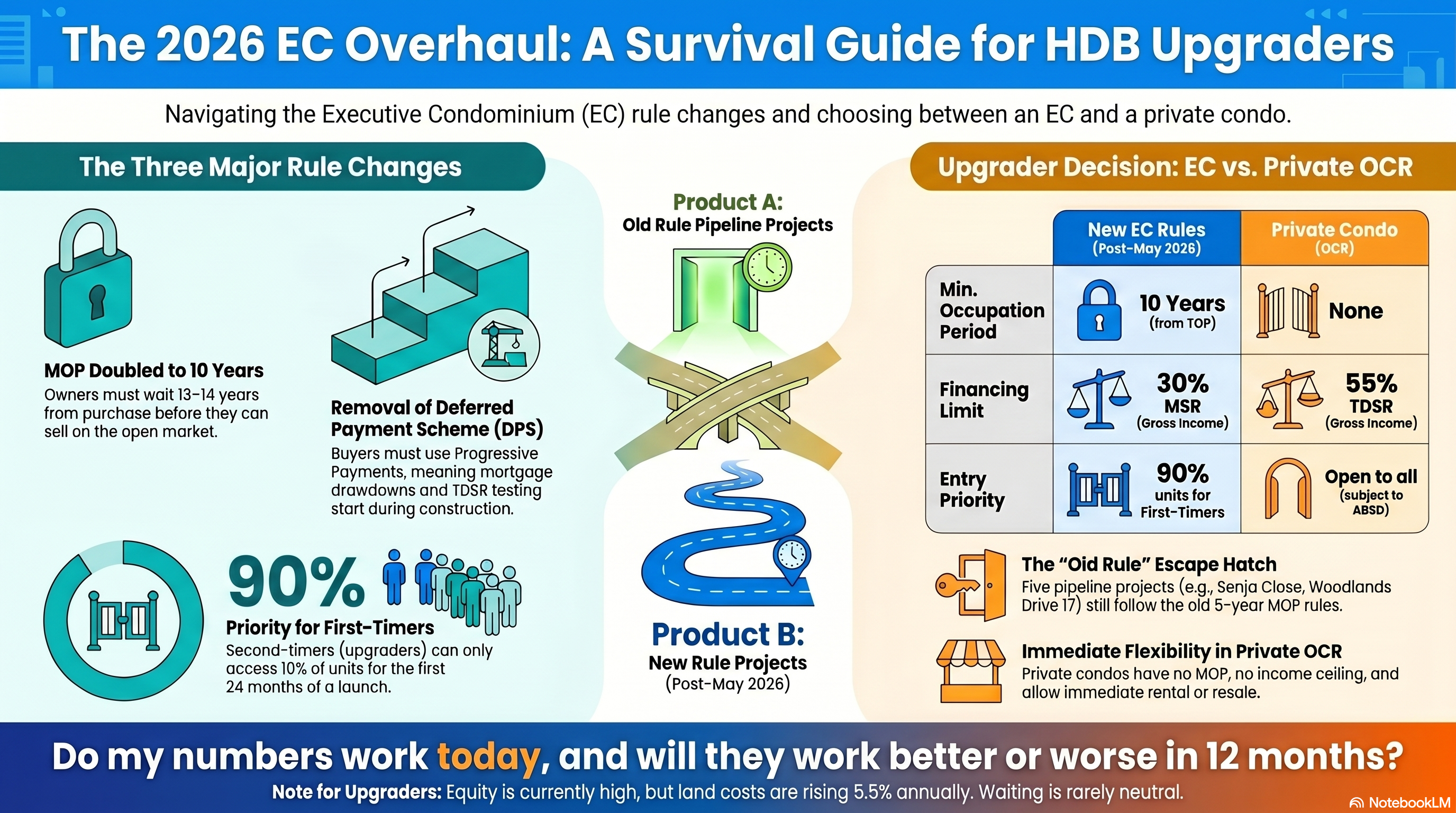
Change 1: MOP doubled from 5 years to 10 years. Full privatisation extended from 10 years to 15 years. Applies to all new EC GLS sites with tender closing dates from 8 May 2026 onwards.
Change 2: Deferred Payment Scheme abolished. All new EC purchases now use the Progressive Payment Scheme only, the same payment structure as private condos. There is no longer any ability to defer your mortgage drawdown until TOP.
Change 3: First-timer priority extended to 90% of units for 24 months. Previously 70% for 1 month. Second-timer HDB upgraders now have access to just 10% of units per new launch for the first two years.
The Real Lock-In Is Not 10 Years. It Is 14.
This is the number most upgraders miss when they read the headline. The 10-year MOP countdown begins only at Temporary Occupation Permit, which is when construction is finished and you collect your keys. Most new EC projects take 3 to 4 years to complete from the date you sign the Sales and Purchase Agreement.
Sign a new-rule EC today. Wait 3 to 4 years for TOP. Then wait 10 more years for MOP. You cannot sell until approximately 2039 to 2040. Full privatisation - meaning you can sell to foreigners and corporate entities - takes 15 years from TOP, or roughly 2041 onwards. The historical EC gain of 130 to 140% within 5 years of MOP is no longer achievable on any comparable timeline under these rules.
The Death of the Deferred Payment Scheme: Why It Hurts Upgraders Most
Under the old Deferred Payment Scheme, EC buyers paid a 5% to 10% booking fee upfront and deferred all remaining payments until TOP. Critically, this meant your TDSR was not tested against the full loan amount during construction. If you were still servicing your HDB loan, the two obligations did not collide until the EC was built and you had already sold your HDB flat.
With DPS gone, all EC purchases revert to the Progressive Payment Scheme. Your mortgage drawdown begins at construction milestones. From the moment the foundation is laid, you are paying an increasing monthly EC mortgage. If you have not yet sold your HDB flat, both your existing HDB loan and your new EC progressive loan are counted against your TDSR simultaneously.
The buy-first-sell-later playbook that DPS enabled is effectively disabled for households with tight debt thresholds. Most upgraders who relied on DPS to manage the transition will now need to sell their HDB first - then rent for 3 to 4 years of construction at Singapore rental rates. Those rental costs alone can erode the entire price discount that made an EC attractive in the first place.
The MSR Sandwich Class Squeeze: The Numbers That Do Not Add Up
Executive Condominiums are governed by the Mortgage Servicing Ratio, which caps your monthly EC mortgage at 30% of gross household income. Private condos use the Total Debt Servicing Ratio at 55%. That gap is the crux of the sandwich class problem.
Take a household earning $12,000 per month. Under the 30% MSR cap, the maximum monthly mortgage is $3,600. At current interest rates, that supports a maximum loan of approximately $750,000. Add a 25% downpayment and the total EC purchase budget is approximately $1,000,000.
At the Rivelle Tampines EC benchmark of $1,839 PSF, a $1,000,000 budget buys approximately 544 square feet. That is a 2-bedroom unit. You cannot comfortably fit a family of four in 544 square feet. The product designed for the sandwich class is pricing the sandwich class out of functional family-sized living.
The same household under TDSR (private condo rules) can service a mortgage of $6,600 per month. The borrowing capacity is substantially higher. The entry price is higher too, but the usable square footage story changes dramatically.
| Factor | New-Rule EC (Post-8 May) | Old-Rule EC (Final Five) | Private Condo OCR |
|---|---|---|---|
| Capital lock-in | 13 to 14 years | 8 to 9 years | 3 years (SSD only) |
| Payment structure | Progressive (PPS) only | Deferred (DPS) available | Progressive (PPS) |
| Second-timer access | 10% first 2 years | 30% | Unrestricted |
| Loan constraint | 30% MSR | 30% MSR | 55% TDSR |
| Expected pricing | $1,800 to $1,900 PSF | Highly competitive premium | $2,100 to $2,200 PSF |
| MOP | 10 years | 5 years | None |
| Full privatisation | 15 years | 10 years | Immediate |
The Final Five: The Last Window of the Old Era
The new rules apply only to EC GLS sites with tender closing dates from 8 May 2026 onwards. Five pipeline EC projects were already in the system before that date and are fully grandfathered under the previous rules. These five projects retain the 5-year MOP, DPS availability, and 30% second-timer priority allocation.
Grandfathered EC Projects - Old Rules Apply
- Senja Close EC (Bukit Panjang)
- Woodlands Drive 17 EC
- Sembawang Road EC
- Miltonia Close EC (Yishun)
- One additional pipeline project
The first new EC sites subject to the full set of new rules are the Canberra Drive site (May 2026 tender) and the Sembawang Drive site (June 2026 tender). Demand for the five grandfathered projects is expected to be intense and front-loaded. Upgraders who have done their financial homework understand that these five launches represent the last chance to buy an EC on the terms that made the product attractive for the past decade.
Once the Final Five are launched and sold, the old EC market is closed permanently. There will be no further grandfathered projects. Every subsequent EC launch will carry the full weight of the 10-year MOP, PPS cashflow obligations, and 90% first-timer priority.
Finding Your Strategy: Four Upgrader Profiles
The 8 May announcement broke the linear HDB-to-EC-to-private upgrading path. The market is now three distinct products. Where you sit depends on your cashflow strength and your holding horizon.
Strong Cash, Long Horizon
Genuine new-era EC owner-occupier. Can carry PPS from construction start. Comfortable holding 13 to 14 years. Willing to compete for 10% of units. Family-first, investment-second mindset.
Strong Cash, Shorter Horizon
Pivot directly to private OCR condos. No MOP. No MSR cap. Immediate rental and resale flexibility. Pay the premium for liquidity and freedom. Cleaner path if your equity supports it.
Tight Cash, Short Horizon
Target the Final Five grandfathered pipeline projects. 5-year MOP, DPS cash flow management, 30% second-timer access. Requires speed. These projects will not last long once they launch.
Tight Cash, Long Horizon
Explore resale ECs that have already passed their 5-year MOP under the old rules. No construction wait, no DPS cashflow complexity, but also no developer discount. Buy what is already built.
The Premium of Freedom: Is the EC Discount Still Worth It?
ECs remain approximately 15% to 20% cheaper than comparable private OCR condos at launch. At $1,800 to $1,900 PSF versus $2,100 to $2,200 PSF for private OCR, the pricing gap is real. The question is whether the new restrictions are worth that discount.
For genuine first-timer families with a 15-year horizon, strong cashflow, and no need for flexibility: yes. The EC still delivers the best entry price into private-style living in Singapore.
For second-timer HDB upgraders who need access to the full product, have tight TDSR, or who need the flexibility to move, rent, or exit within 10 years: the calculus has fundamentally shifted. The private OCR market is now the cleaner path, at a premium, but with immediate liquidity, 55% TDSR borrowing power, and no MOP hanging over every life decision.
The speculative premium that the EC once supported - the 130 to 140% gain within 5 years of MOP - is being systematically priced out of the product. That premium existed because of DPS cash flow advantage and the 5-year flip window. Both are now gone for new launches. The EC is being returned to its original purpose: a long-term home for genuine owner-occupiers, not a subsidised investment stepping stone.
The question is not a generic "should I upgrade?"
The question is: do my numbers work today,
and will they work better or worse in 12 months?
Waiting is not a neutral position. Every month of delay on the Final Five is a month closer to those launches selling out. Every month of delay on the private OCR market is a month of GLS land cost escalation at 5.5% annually locking in a higher price floor for future launches. OCR new launches are already at $2,100 to $2,200 PSF with projections past $2,700 PSF as the pipeline tightens.
Run your net equity calculation. Gross HDB selling price is a vanity metric. Subtract your outstanding loan, CPF refund with accrued interest, and transaction costs. What remains is your real upgrading power. Then stress-test your TDSR with both loans running simultaneously under PPS. Then decide whether EC or private OCR gives you the right combination of price, space, and flexibility for your household's actual circumstances.
This topic is covered in depth in Episode 23 of Real Estate Unfiltered: Singapore on Spotify - "The 14-Year Trap." Search Keith Tan on Spotify or YouTube to listen to the full breakdown.
Want to run your own upgrade numbers?
I will walk through your actual net equity, TDSR position, and cashflow scenario before you commit to anything. No obligation. Just honest numbers.
WhatsApp Keith Free Property ValuationGeneral information only.Estimates only, not guaranteed, figures may change. Property purchases involve significant financial commitments and individual circumstances vary. Always consult a qualified financial adviser and legal professional before making any property decision. Keith Tan Boon Kee, ERA Realty Network Pte Ltd (CEA Reg. No. R003793E). Data sourced from MND announcement 8 May 2026, URA, Stacked Homes, Mothership, and industry analysis. Accurate as of 11 May 2026.