
A ballistic missile is intercepted over the Middle East, and 48 hours later, concrete for a new Singapore condo costs 15% more. A billionaire in Dubai swallows a 60% stamp duty just to move his family to Orchard Road. These are not hypothetical scenarios. This is the mechanical reality of the 2026 Iran war landing on Singapore property - and most commentary is only telling you half the story.
1. The Strait That Moves Your Mortgage
On 28 February 2026, US and Israeli forces launched Operation Epic Fury. Iran retaliated with waves of ballistic missiles and drones. Within 24 hours, tanker traffic through the Strait of Hormuz - through which 20% of global oil and 22% of global LNG normally passes - fell by 94%. The IEA called this the largest supply disruption in the history of global oil markets.
Brent crude spiked from $70 to briefly touch $120. Today, after four volatile weeks, oil is trading around $100 to $104 - still 45% above where it started. Singapore's 95-octane petrol has already hit $2.97 a litre. Every US$10 increase in crude oil historically adds 0.3 to 0.5 percentage points to Singapore's headline CPI.
Here is the chain connecting that chokepoint to your SORA rate. Higher energy prices drive imported inflation across Singapore, which imports virtually all its energy. The Fed and MAS cannot cut rates into rising inflation. Those rate cuts buyers were pricing in for late 2025 and early 2026 are now officially deferred - Q3 2026 at the very earliest, and that assumes a ceasefire materialises.
Key mechanism: Borrowing money will stay significantly more expensive for much longer than anyone modelled three months ago. If your purchase plan assumed a rate cut this half, rebuild that assumption from scratch today.
2. Why New Launch Prices Have a Floor That Cannot Move
The modern construction site is a massive consumer of fossil fuels - directly through diesel running excavators, cranes, and logistics trucks, and indirectly through the manufacturing of cement, steel, PVC pipes, waterproofing membranes, insulation foams, and petrochemical finishings. Every one of these costs has moved up sharply.
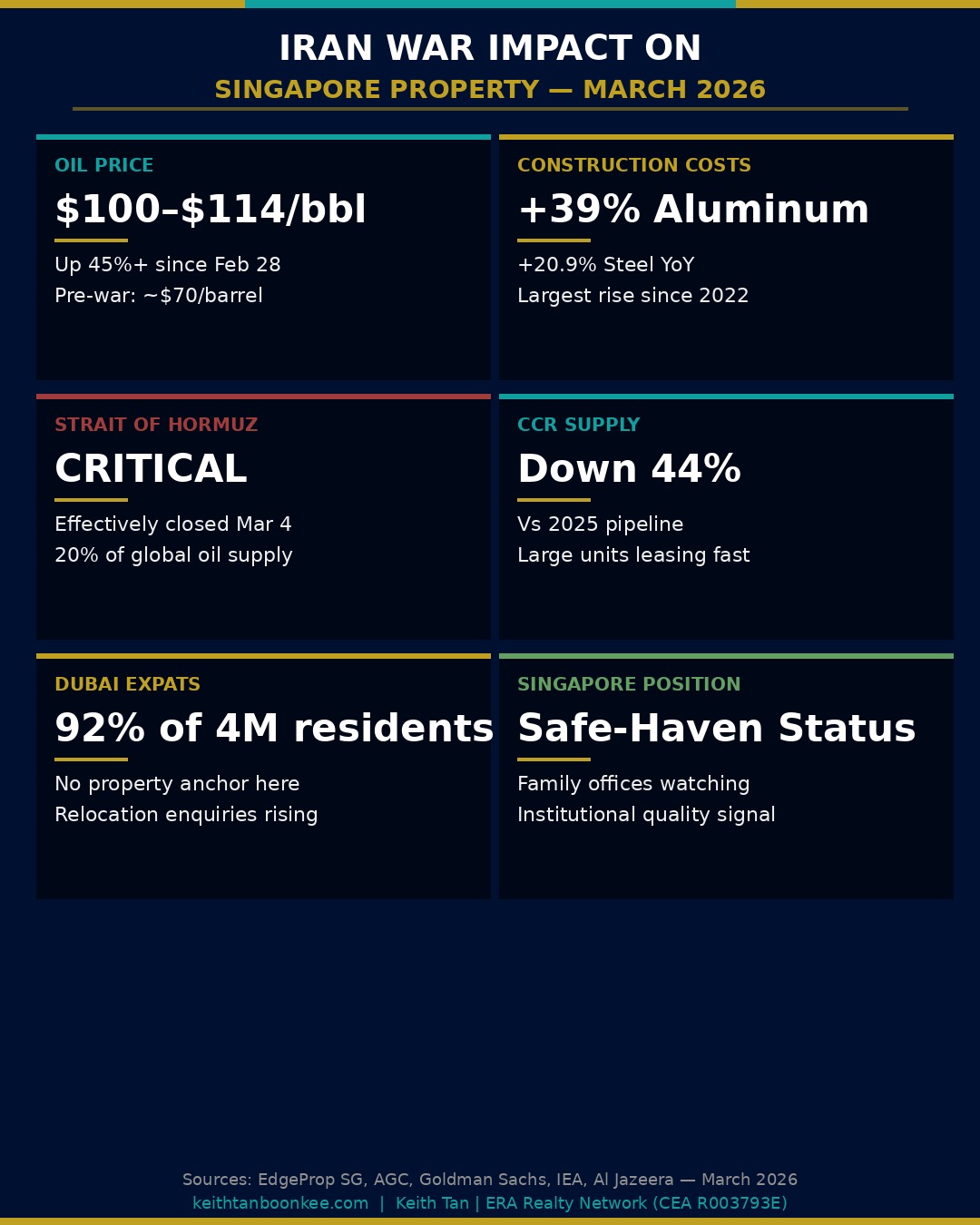
ERA's market intelligence projects construction cost inflation of 9 to 13% in Singapore directly attributable to this oil shock. In a worst-case sustained-disruption scenario, the range stretches to 15 to 18%. Fabricated structural steel is up 20% year-on-year. Aluminum is up 39%. Cargo ships carrying imported materials now carry war-risk insurance premiums and significantly higher bunker fuel costs.
Think of it this way. A developer who bought a GLS site at a premium price last year ran feasibility on 2025 construction costs. They are now looking at a 13% spike in building costs before breaking ground. Can they lower their launch price to attract cautious buyers? No. They mathematically cannot take a loss on the project. The break-even point has permanently moved.
"Developers have zero room to lower new launch prices into a cost-push environment. Pre-committed land prices prevent downward adjustments. Current unsold inventory may represent relative value."
- Singapore Property Geopolitical Outlook, Market Intelligence ReportThis creates a counterintuitive opportunity. Projects launching in 2027 will fully bake in newly inflated construction and land costs from day one. Launches selling today may actually look inexpensive in retrospect.
3. The Capital Flight Story Most People Are Missing
If higher construction costs and deferred rate cuts were the whole story, you would expect a sharp market slowdown. But there is an immense unexpected counterforce - generated directly by the conflict zone itself.
Dubai has roughly 4 million residents. About 92% are expatriates. They rent. They have no property anchor here. When the UAE's aura of being an untouchable, insulated safe haven was shattered by drone strikes near Dubai Creek, fires at the Fujairah bunkering hub, and hits on Kuwait International Airport, wealthy families started moving fast.
Private wealth lawyers in Singapore are reporting multiple clients, each with average assets above US$50 million, demanding immediate asset transfers to Singapore. Asian families and family offices with heavily concentrated Dubai positions are looking to relocate operations and families here.
The math makes the logic clear. If you are holding a $50 million portfolio in Dubai and drones are hitting infrastructure a few miles from your office, Singapore's 60% ABSD on foreign purchases - roughly $4.8 million on an $8 million Orchard Road penthouse - is not a barrier. It is a rounding error. The known acceptable cost of physical security, institutional stability, and rule of law. Physical security has a demonstrably higher ROI than tax optimisation right now.
How they are moving the money: VCC structures
These families are not simply wiring funds to a Singapore bank account. They are utilizing Singapore's Variable Capital Company structure - a highly flexible corporate vehicle that allows ultra-wealthy families to pool real estate, global equities, and private equity into a single umbrella entity, with massive tax efficiencies at the corporate level, cross-border operational flexibility, and extreme privacy while acquiring prime property and establishing a new base. These families are landing at Changi Airport today and needing a place to live while their VCCs are being incorporated.
4. What This Is Doing to the Rental and Property Market
The demand profile from Gulf relocators is specific and consistent across multiple sources: three-bedroom and four-bedroom condos in Districts 9, 10, and 11 - Orchard, River Valley, Bukit Timah - with proximity to Tanglin Trust and the Singapore American School. These families have children. They need space and educational infrastructure immediately.
| Segment | War Impact | Direction |
|---|---|---|
| CCR 3BR/4BR rental | Demand spike from Gulf relocators. Supply down 44% from 2025. Large units leasing faster than rest of market. | Rental floor firming. Pricing power returning to landlords. |
| CCR new launches | Developer price floor locked in by construction costs and GLS land bids. Zero room to discount. | Prices hold. Current unsold stock may represent value vs 2027 launches. |
| Resale market | Individual sellers may be anxious about slow volumes. No mathematical floor like developers. Negotiation room exists. | 10 to 25% discount vs adjacent new launches possible. Smart entry for local buyers. |
| HDB upgraders / OCR | Rising utility costs, elevated rates, energy-driven inflation squeezing disposable income. | Proceed on fundamentals. Lock fixed rates. Do not plan around deferred cuts. |
| Sellers | Volume has slowed. Buyers are cautious. | Price realistically. Aspirational premiums will sit. |
5. Why Singapore Property Does Not Crash in a Crisis
If construction costs are rising and buyers are cautious, why is the Singapore property market not collapsing? The answer is structural, not speculative.
Singapore's TDSR framework means every buyer who took out a mortgage in recent years was stress-tested not at the actual 1.5 to 2% rate available at the time, but at a hypothetical 4 to 4.5%. They were mathematically proven to handle significantly higher monthly repayments before they were allowed to borrow. With mortgage rates currently around 3.5 to 3.8%, most local buyers are within the stress-test buffer they already passed. There is no subprime crisis here. Local owners are not over-leveraged. They have holding power.
History confirms this. In 2008, Singapore's market corrected through time, not through price collapse. Transaction volumes fell sharply, but owners did not slash prices by 30 to 40% to liquidate. They held and waited. The same pattern played out in 1997 and 2020.
"Singapore property corrects through time, not through price collapse."
- Singapore Property Geopolitical Outlook, Market Intelligence ReportIn the current environment, safe-haven inflow from Gulf relocators partially offsets local buyer hesitation at the top end. At the base, TDSR prevents forced selling. The result: volumes slow, prices hold.
6. Two Scenarios and Their Probabilities
Base Case: Prolonged Conflict
55% PROBABILITYConflict grinds on for months. Oil oscillates at $90 to 110. Hormuz remains severely disrupted. Rate cuts off the table. Construction costs keep rising. Transaction volumes slow but prices hold. CCR safe-haven demand accelerates. 2027 launches price in wartime cost premiums - making today's inventory look cheaper in retrospect.
Alternative: Quick Resolution
45% PROBABILITYCeasefire within weeks. Hormuz reopens. Oil retraces to $75 to 80. Rate cuts resume late 2026. Market volume accelerates as pent-up demand is released. Buyers who acted during uncertainty are positioned well. Note: construction cost inflation does not reverse - it was structural, not temporary.
As of 25 March (Day 25), Trump claimed peace talks are underway and ordered a 5-day pause on power plant strikes. Iran denied any contact. Oil dropped 11% on the news, then bounced back above $100 within 24 hours when Iran's denial landed. Goldman Sachs still forecasts Brent averaging $110 through April. The base case remains prolonged conflict.
7. The Strategic Playbook by Buyer Profile
HDB Upgraders
Proceed on fundamentals, not on the assumption of rate cuts. Lock in a 2 to 3-year fixed rate mortgage immediately. Certainty in your monthly overhead is worth more than chasing a floating rate that may not move when you expect.
Resale Buyers
This is your window. A 10 to 20-year-old condo in the city fringe may offer a 15 to 25% discount vs an adjacent new launch. The resale seller may be anxious about slow volumes - that is negotiation room the developer cannot offer. Target older condos with wider value gaps.
Investors
Underwrite for rental yield, not capital gains. Model your purchase against a 3 to 3.5% rental yield floor. A property that covers its own mortgage during a low-volume period is the only kind worth holding through uncertainty.
Sellers
Price realistically. Aspirational premiums will sit. Volume is slow and buyers are cautious. Well-priced, well-presented properties still move - but the days of multiple above-asking offers in a week are not today's market.
8. The Final Thought Worth Sitting With
We have just mapped how a kinetic war 7,000 kilometres away has the power to permanently shift the world's family offices and ultra-wealthy out of the Middle East and into Singapore. The speed of that capital flight has been extraordinary. If global capital now demands physical security above everything else - above tax optimisation, above returns, above convenience - what does that mean for the long-term structural value of a tiny, fiercely protected island nation over the next decade?
Singapore has survived 1997, 2003, 2008, 2020, and 2022. The structural case remains unchanged. This market rewards the prepared, the disciplined, and the mathematically sound.
Want a straight read on your specific situation?
Whether you are an upgrader, a landlord with a large CCR unit, a buyer hunting the resale gap, or an investor - I am happy to walk through the numbers with you privately. No pitch, no pressure.
WhatsApp Keith - +65 9750 1055WeChat: keithtanbk | keithtanboonkee.com
🎙 Listen: Real Estate Unfiltered Singapore - Iran War Deep Dive on Spotify
General information only. Estimates only, not guaranteed, figures may change. Market conditions are subject to change. Analysis draws on publicly available data from Al Jazeera, CNN, EdgeProp Singapore, AGC, Goldman Sachs, IEA, Standard Chartered, Reuters, Straits Times, Business Times, ERA Market Intelligence Reports, and NotebookLM research synthesis, as at 25 March 2026. Probability estimates are from third-party intelligence sources and are not guarantees of outcome. Keith Tan Boon Kee, ERA Realty Network Pte Ltd, CEA Reg. No. R003793E.